AI Tracker
Models news,
for builders.
The latest models news from every AI provider: launches, price changes and retirements, summarized with what they mean for you.
Artificial Analysis releases Intelligence Index v5, with Claude Opus 5.5 on top
Artificial Analysis published version 5 of its Intelligence Index, a composite of model capability, with two new benchmarks and three upgrades. It says that for the first time most of the index is built on private datasets. It also launched a Progress Index v1 that places language models released since November 2022 on one capability scale.Anthropic says an unreleased Claude model built five exploit chains, including a one-click Chrome attack with 62 CVEs patched in Chrome 156
Anthropic's Frontier Red Team published "Discovering and exploiting vulnerabilities in critical, real-world software with Claude" on October 27. The account below comes from a post summarizing the article, not from the article itself.Anthropic shares early results from drug-development partnerships
Anthropic says its scientists have spent the past few months in research partnerships with six organizations developing new medicines (BigHat Biosciences, Bristol Myers Squibb, Divergence Labs, Enveda, Generate Biomedicines and The Column Group), and have begun drug discovery efforts of their own. In a blog post it shares early results and says it has learned how Claude can support the many stages of drug development. The post also describes how this work fits Anthropic's wider ambitions in the life sciences.Google Research proposes a "sleep" phase so LLMs can keep learning without forgetting
Google Research published "The sleep framework" on October 27, 2026 (Ali Behrouz and Vahab Mirrokni). It describes a continual-learning approach in which a deployed model alternates between an active phase, holding new information in short-term memory, and a sleep phase, when it stops taking input and consolidates that memory into its weights.Anthropic study: analysts using Claude Code followed the agent's hidden lean on 86% of judgment calls
Anthropic published a study of how an AI agent shapes expert decisions. It ran a randomized trial with 50 professional analysts (experienced in causal inference) who analyzed whether a fictional farming cooperative's advisory program worked, using Claude Code with Claude Opus 4.8 at High effort. According to Anthropic:Liquid AI introduces LFM3, six small models across text, vision, audio and omni
Liquid AI announced LFM3, a new generation of its Liquid Foundation Models built on what it calls a new tri-hybrid architecture, with new multimodal encoders. It says the architecture is optimized for 14 processor classes across GPUs, CPUs and NPUs, and that the models can be fine-tuned on one GPU.Google DeepMind introduces Genie 4, a real-time interactive world model
Google DeepMind announced Genie 4 on October 27, 2026, calling it its most realistic and interactive world model yet. In its post, DeepMind says users can explore dynamic environments in real time and see how the scene responds, sounds, and how the people in it move, react and speak. It published a blog post, "Genie 4: a new generation of world simulation".Microsoft's MAI-Image-2.7-Preview ranks #2 on Artificial Analysis image editing
Artificial Analysis says Microsoft AI's MAI-Image-2.7-Preview, the newest image editing model and successor to MAI-Image-2.6 (released in August), takes second place on its AA-Image-Editing v2.1 leaderboard, close behind OpenAI's GPT Image 2.5 Sunburst (max). The results are Artificial Analysis's own.SenseTime reportedly open-sources SenseNova 6.8 Code2Video, a 27B code-to-video model
A Chinese AI blogger reports that SenseTime open-sourced SenseNova 6.8 Code2Video on October 27, with weights on Hugging Face under sensenova/SenseNova-6.8-Code2Video. The report is second-hand; SenseTime's own announcement is not cited.Axiom says AI agents formalized the Classification of Finite Simple Groups in Lean
Axiom, an AI math company, announced on X a complete Lean auto-formalization of the Classification of Finite Simple Groups, a result it calls the "periodic table of symmetry". It describes the original proof as about 15,000 pages written by over 100 mathematicians across generations, and calls it the largest math proof in history to be computer-verified.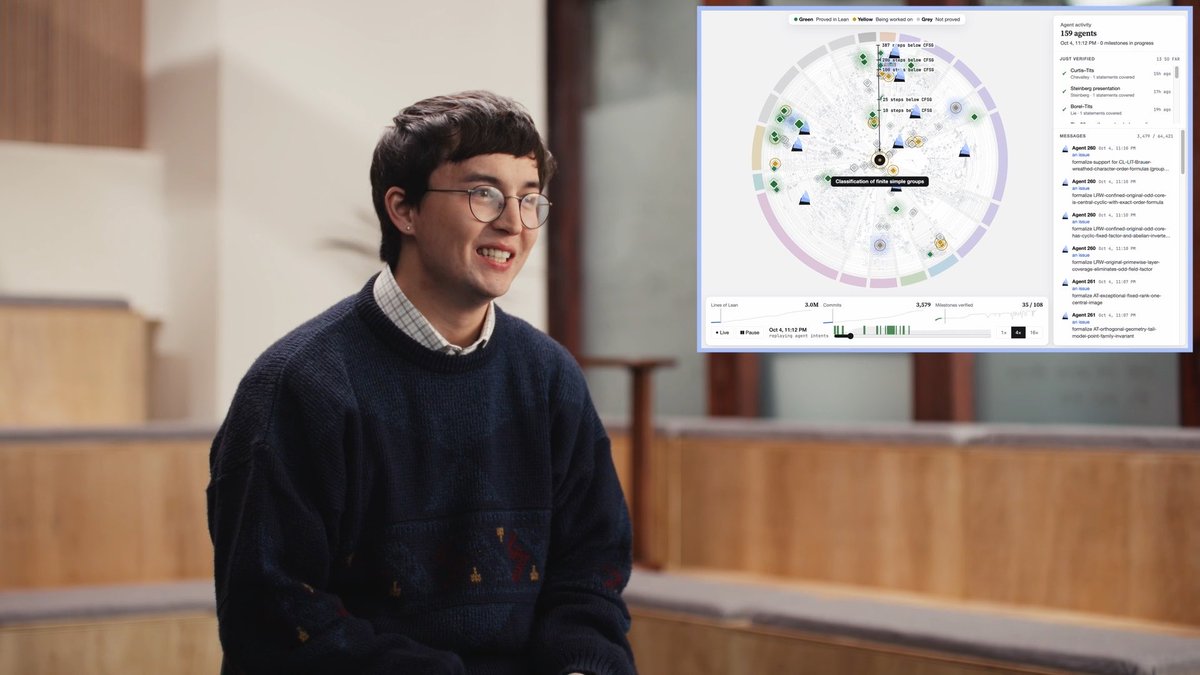
Ling releases the open weights of Ling-3.1-flash-1019 and a base model
The Ling team says Ling-3.1-flash-1019 is now open source, with weights on Hugging Face and ModelScope. It also released Ling-3.1-flash-base, which it describes as an open foundation for further training. The team says the new model had further post-training for reasoning and real-world agent workflows.OpenRouter's catalog gives Meta: Llama 3.1 70B Instruct an expiration date of November 3
OpenRouter's model catalog now shows an expiration date of November 3, 2026 for "Meta: Llama 3.1 70B Instruct" (meta-llama/llama-3.1-70b-instruct), a model listed since July 23, 2024 with a 131,072-token context. The entry had no expiration date before. This is a catalog field; neither OpenRouter nor Meta has given a reason in what we have seen, and the entry does not say what happens to the model after that date.Maya-2, a voice model for Indian languages, is released with open weights
Maya-2, a voice (speech synthesis) model aimed at India, was published with open weights on October 27 under the Hugging Face name maya-research/maya2-native. The announcement on X says it covers more than 1.5 billion people across all 28 states and 8 union territories.